
Connecticut Criminal History Checks
Start with the question, not a name box. A pending or disposed prosecution belongs in the Connecticut Judicial Branch Criminal and Motor Vehicle Case Look-up. A police narrative belongs with the municipal department or State Police troop that handled the event. Present custody belongs in the CT DOC search. An official Connecticut conviction product or a close review of your own record belongs with Connecticut SPBI. Registry status has its own DESPP system. Each source answers a smaller question than the phrase “criminal history” suggests.
Run pending and conviction court routes separately. Save the docket number and court location because both guide a clerk request. Treat a web result as a lead, not a certified court record. If the person may still be held, search CT DOC as a separate step. For a recent incident, identify the police agency and request its releasable report. Use the Connecticut locality directory when the creating office is unclear.
- Choose the case, police, custody, registry, or SPBI channel that fits the question.
- Search with the exact legal name, known aliases, birth details, docket, or agency number.
- Compare the source dates and keep the court location tied to the result.
- Request the original report or court file when the online summary is not enough.
- Use a fingerprint-supported SPBI product for a high-confidence review of your own Connecticut record.
Note: A blank result in one Connecticut system does not establish that no arrest, case, custody entry, or erased record ever existed.
Connecticut Arrests Reach SPBI
A Connecticut record begins with a municipal police department, State Police troop, campus department, tribal agency, or other authorized unit. Booking can produce identity data, alleged charges, a photograph, and fingerprints. A fingerprint-supported submission may enter SPBI with a transaction control number. Prosecutors and the state Judicial Branch then create filed charges, docket events, dispositions, and sentences. Reported results can update the SPBI history.
The three main records remain distinct. Police keep the narrative and original allegation. Superior Court shows what prosecutors filed and how the case ended. SPBI compiles reported identity, arrest, and disposition information. Timing, aliases, fingerprint quality, corrections, older paper practice, and erasure can cause differences. The Connecticut arrest search follows this chain in more depth.
Record path: Police event → Booking and fingerprints → Superior Court case → Disposition → SPBI history.
The Criminal History Repository in Connecticut
The Connecticut Department of Emergency Services and Public Protection houses the State Police Bureau of Identification. Connecticut SPBI sits between arresting agencies, courts, authorized state users, and FBI systems. It is the statewide identification and criminal-history repository. Its public products do not turn CCHRS into an unlimited name-search database. Instead, official requests use defined products, forms, service codes, and identity controls.
The $36 Connecticut-only name and date-of-birth search answers whether a record exists. It does not supply the record. A $75 name and date-of-birth request returns a Connecticut conviction history only if one exists. The $75 fingerprint product gives a stronger match and is the best SPBI route for reviewing your own record. Fingerprint capture is a separate service and fee. The full agency profile appears under Connecticut SPBI criminal history checks.
Connecticut CCHRS Request Fields
The Connecticut Criminal History Request System uses a service code to control the product, recipient, and fee in coded workflows. The code is supplied by the program that requires it. It should never be guessed. Electronic pre-enrollment gathers requester identity and contact information, then creates the confirmation, tracking number, and barcode needed for a fingerprint appointment.
| Field or Control | Use | Requirement |
|---|---|---|
| Agency Provided Service Code | Selects the authorized workflow | Required for coded programs |
| Requester identity | Connects the enrollment to the person | Required |
| Sends confirmation or permitted results | Required electronically | |
| Barcode and tracking number | Connects pre-enrollment to fingerprint capture | Bring to appointment |
| Government photo ID | Confirms identity at capture | Required |
CCHRS pre-enrollment is not itself the criminal-history result. The applicant must complete the workflow and, when required, appear for fingerprint capture with accepted identification.
Note: A Connecticut CCHRS service code comes from the official program and should never be guessed or borrowed from another workflow.
Record Systems Across Connecticut
Connecticut centralizes courts, corrections, probation, and criminal-history identification at the state level, but police reports remain with the agency that made them. This design changes the normal county-record model. The right system depends on whether the reader needs a filed case, compiled conviction history, present custody, public registry profile, or event narrative.
That distinction keeps each Connecticut criminal record search tied to its source.
| System | What It Holds | Run By |
|---|---|---|
| CCHRS and SPBI products | Official Connecticut criminal-history products | DESPP, Division of State Police |
| Criminal / Motor Vehicle Case Look-up | Public pending, conviction, and docket routes | Connecticut Judicial Branch |
| CT DOC Offender Information Search | Unified state custody and public status fields | Connecticut Department of Correction |
| Connecticut Sex Offender Registry | Statutorily published registration information | DESPP Registry Unit |
| Police report channels | Incident, arrest, crash, and releasable evidence records | Creating municipal agency or State Police |
Connecticut DOC Custody Records
Connecticut has no county jails. Municipal lockups hold people for a short time, while CT DOC runs a unified system that includes unsentenced and sentenced custody. The public locator accepts a CT DOC inmate number or name and date of birth. A profile may show current location, admission date, status, controlling offense, sentence information, estimated release, special parole, and detainers. The feed updates nightly. “Accused” status means the person may be awaiting trial, not convicted.
The OPM correctional research and dashboard hub supplies current population context and trend products.
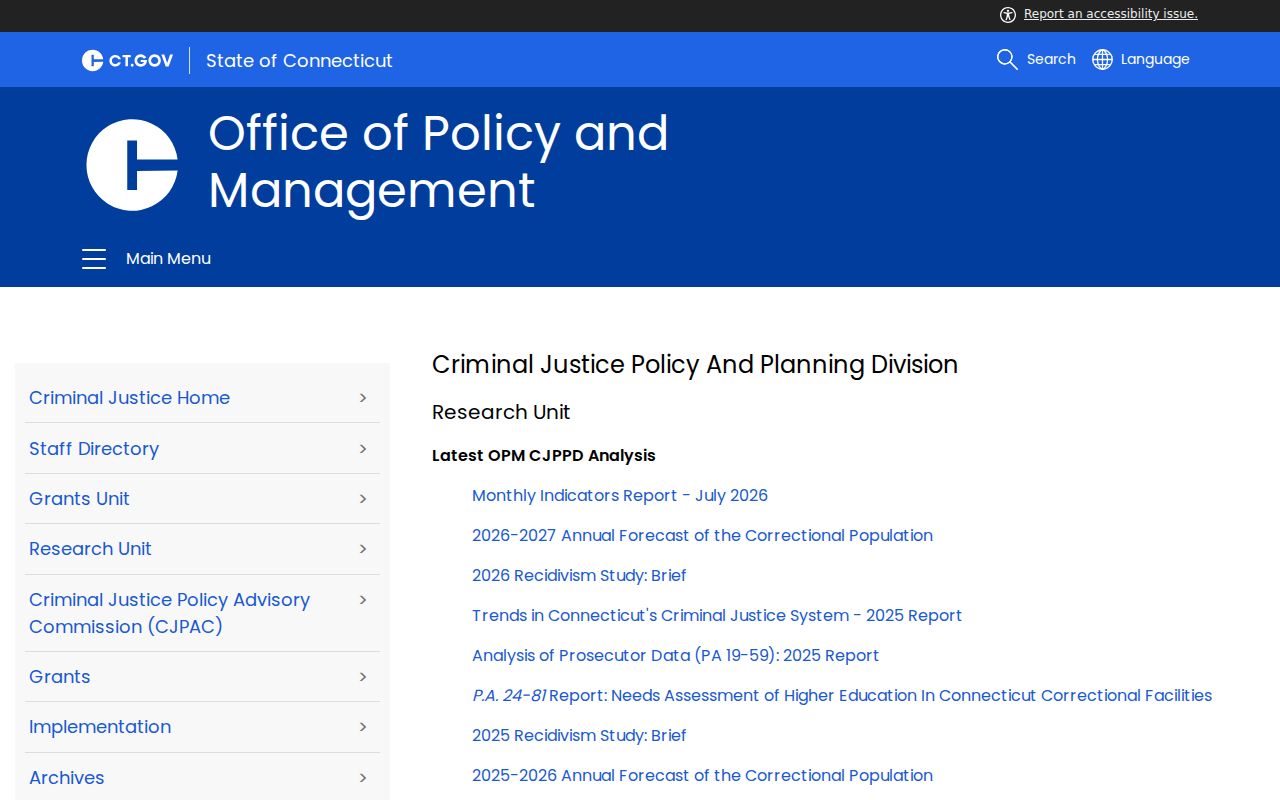
The dashboard route is better for system totals and trends. The CT DOC locator is the source for a specific public custody entry, while the Superior Court file controls the criminal case outcome.
Connecticut Criminal Record Types
A single Connecticut event can create several records. The incident or arrest report describes the police response. Booking and CT DOC entries describe intake or custody. A Superior Court file contains filed charges, appearances, orders, disposition, and sentence. SPBI assembles reported identity-linked history. Warrants, supervision records, and registry profiles serve still narrower purposes.
- Docket number
- The Superior Court case identifier and strongest key for a court search.
- Disposition
- The result entered for a count, such as conviction, dismissal, acquittal, or nolle.
- Rap sheet
- An identity-linked criminal-history compilation, not the police narrative or full court file.
- Erasure
- Connecticut's statutory removal of covered records from ordinary disclosure, not just removal of a web link.
- Special parole
- Post-release supervision imposed as part of certain Connecticut sentences.
Note: Connecticut police, court, custody, repository, supervision, and registry records describe different parts of the same justice process.
Connecticut Warrant Records Stay Narrow
Connecticut's Paperless Arrest Warrant Network and WANTED data are chiefly justice-user systems. They are not a full public statewide name search. OPM does publish a narrower Violation of Probation warrant interface. It can be searched with a name, town, or court location and may show a related court or warrant identifier. The town field may reflect source data and should not be read as a current home address.
The public Connecticut VOP warrant source demonstrates that limited scope.
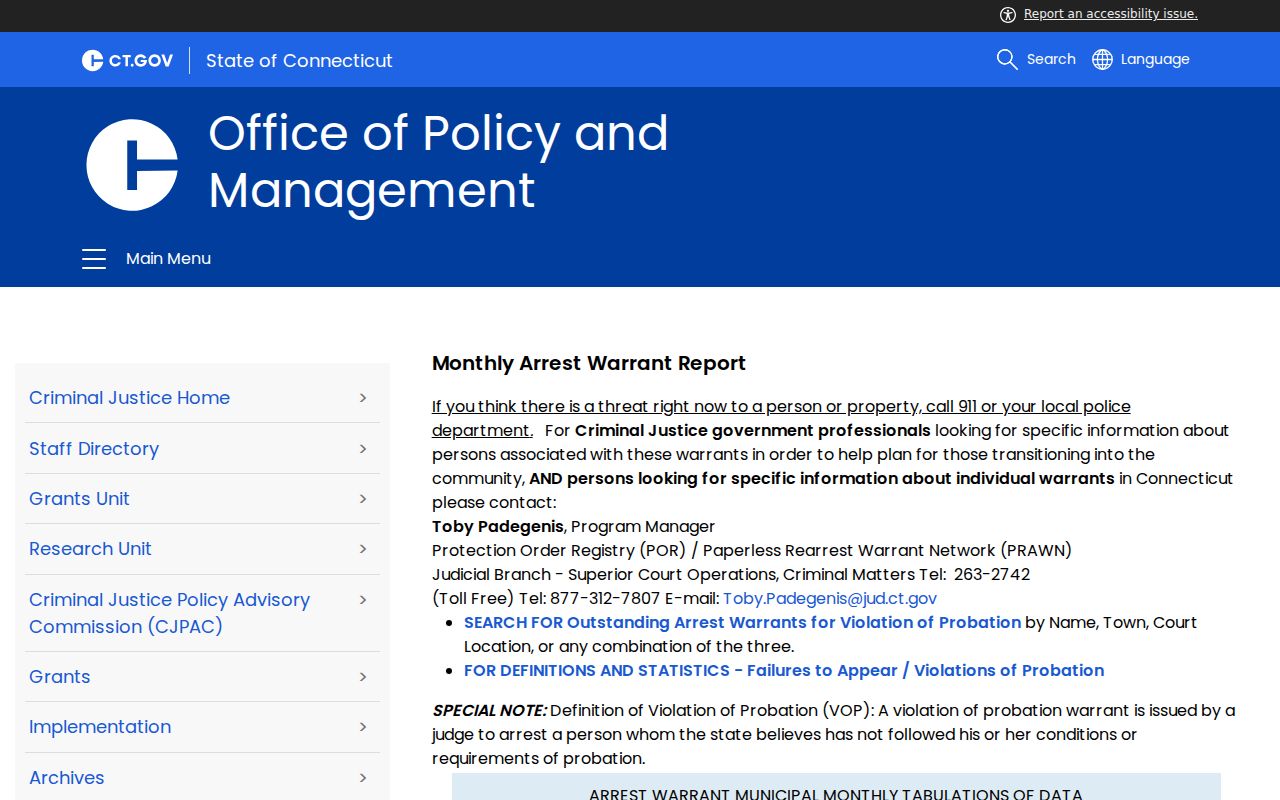
The VOP tool excludes ordinary arrest, bench, search, fugitive, juvenile, and sealed warrants. A public search does not clear a warrant. A person concerned about their own record should use the named Superior Court and obtain legal advice on the correct appearance or surrender process.
Connecticut Probation and Police Records
Adult probation is state-run through the Judicial Branch Court Support Services Division. A court docket can confirm the probation sentence and public violation events. Detailed officer notes and supervision plans are not a general public name-search product. Parole is separate. The Board of Pardons and Paroles makes release and pardon decisions, while DOC Parole and Community Services manages supervision.
The Connecticut Board of Pardons and Paroles source distinguishes that authority from probation and court records.
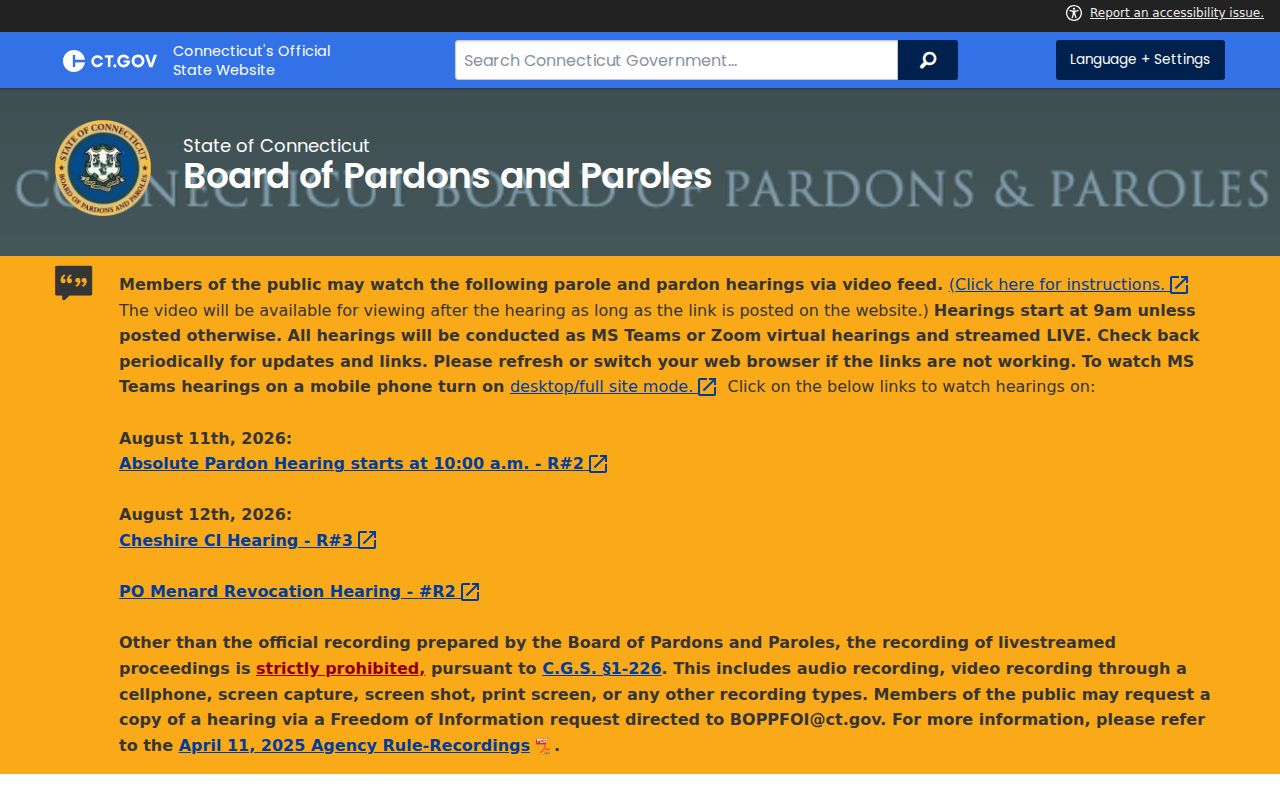
A State Police incident report also differs from an SPBI history. DESPP routes incident and crash requests through report-specific channels, and municipal reports stay with each local agency.
The Connecticut State Police reports source lays out the incident, crash-summary, and GovQA choices.
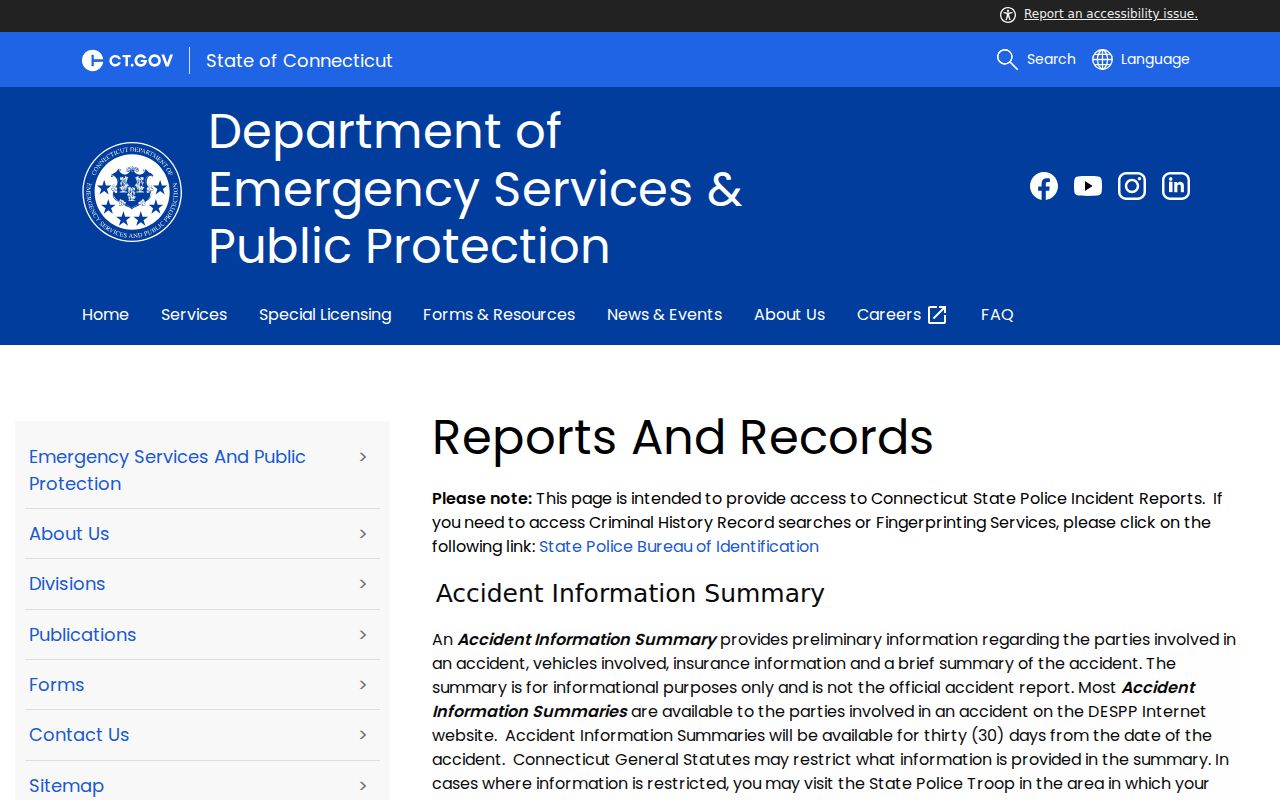
The source helps a requester choose the record created by State Police instead of ordering an SPBI conviction product that cannot supply the police narrative.
Note: Connecticut probation, parole, police reports, and SPBI histories are maintained through separate state or local agency channels.
Connecticut Record Access Laws
The Connecticut Freedom of Information Act starts with access to public-agency records, subject to exemptions in state and federal law. It does not shift custody between agencies. Police release their records, the Judicial Branch clerk releases the court file, CT DOC supplies custody data, and SPBI supplies its own products. Redaction may protect victims, juveniles, medical data, active investigative facts, and other restricted information.
Key Connecticut laws:
CGS §1-210 opens public records unless another law provides an exemption.
CGS §1-212 governs copies, media costs, and fee waivers.
CGS §1-215 preserves a core public record of an adult arrest.
CGS §54-142k limits dissemination of nonconviction criminal-history data.
CGS §54-142a governs covered erasures, including dismissed, acquitted, nolled, pardoned, and eligible Clean Slate matters.
Public access can change as a case moves. An arrest may be public before final disposition. An erased matter should later leave ordinary public systems. Neither an old allegation nor a missing web entry should be treated as a current judgment.
Connecticut Erasure and Clean Slate
Connecticut erasure covers several paths. Qualifying acquittals and dismissals erase after appeal time or final review. Nolled charges generally erase after 13 months. An Absolute Pardon can erase the covered adult Connecticut record. Clean Slate extends relief to eligible convictions after the sentence and waiting conditions are met. Eligible misdemeanors generally use a seven-year wait; eligible Class D, E, qualifying unclassified felonies, and certain impaired-driving matters use ten years. Family-violence-designated, sexual, and other listed offenses are excluded.
The official Connecticut Clean Slate eligibility source gives the current limits and missed-erasure hearing route.
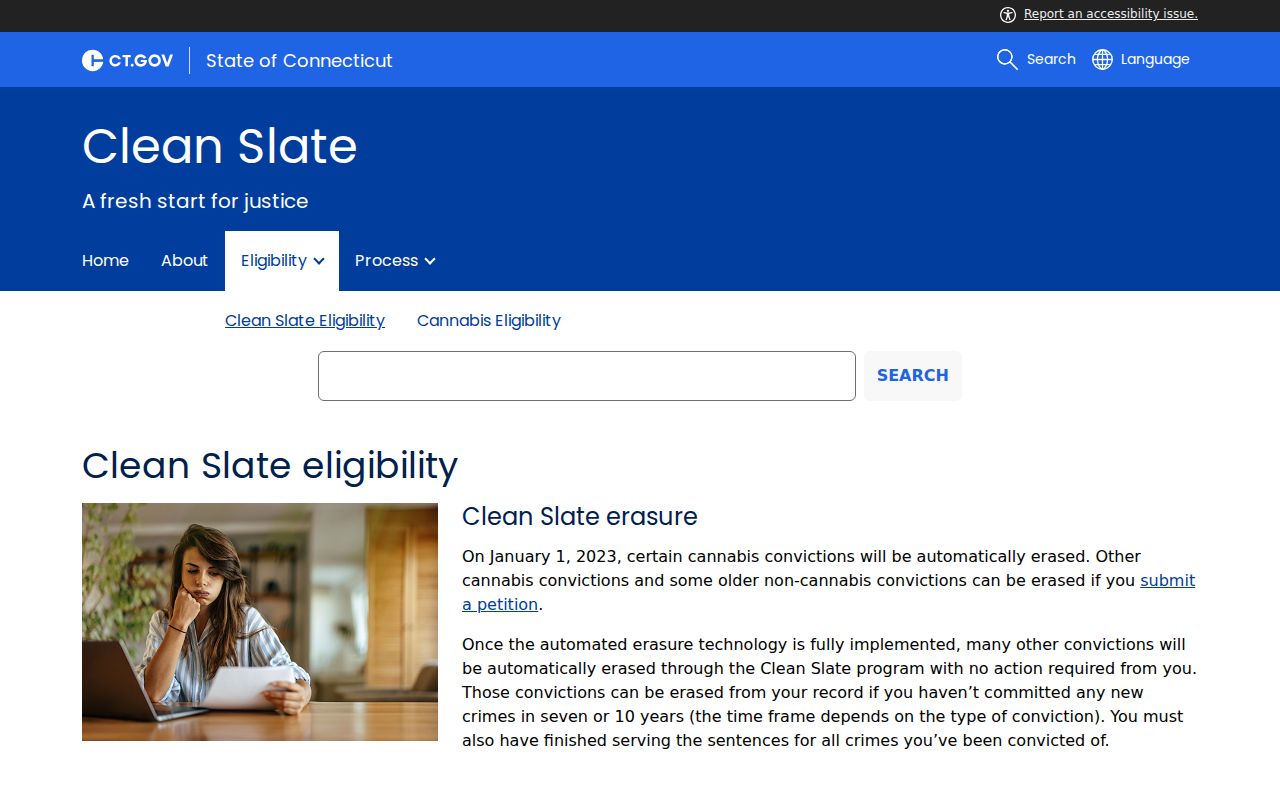
If an eligible post-2000 conviction was missed, obtain a current SPBI history and use DESPP-0847-C. Eligible older convictions may require JD-CR-202 in the sentencing court. Connecticut reported about 50,000 people had partial or complete erasures when processing resumed after data-system delays. That dated figure shows why a fresh official review matters.
Connecticut Criminal History Fees
Connecticut fees depend on the product. A name-only existence answer is not the same purchase as a conviction record, and fingerprint capture is not included in the history charge. General SPBI requests are mailed under the published instructions. Purpose-specific CCHRS workflows can use a service code and electronic pre-enrollment. Local police copy and fingerprint charges vary within lawful limits.
| Connecticut Item | Amount |
|---|---|
| SPBI name/DOB existence search | $36 |
| SPBI name/DOB conviction history | $75 |
| SPBI fingerprint conviction history | $75 |
| SPBI fingerprint capture | $15 |
| Absolute Pardon application | No Board fee; SPBI report separate |
| State Police Accident Information Summary | Free during the published summary window |
The Connecticut Accident Information Summary source is a separate report tool for many State Police crashes.
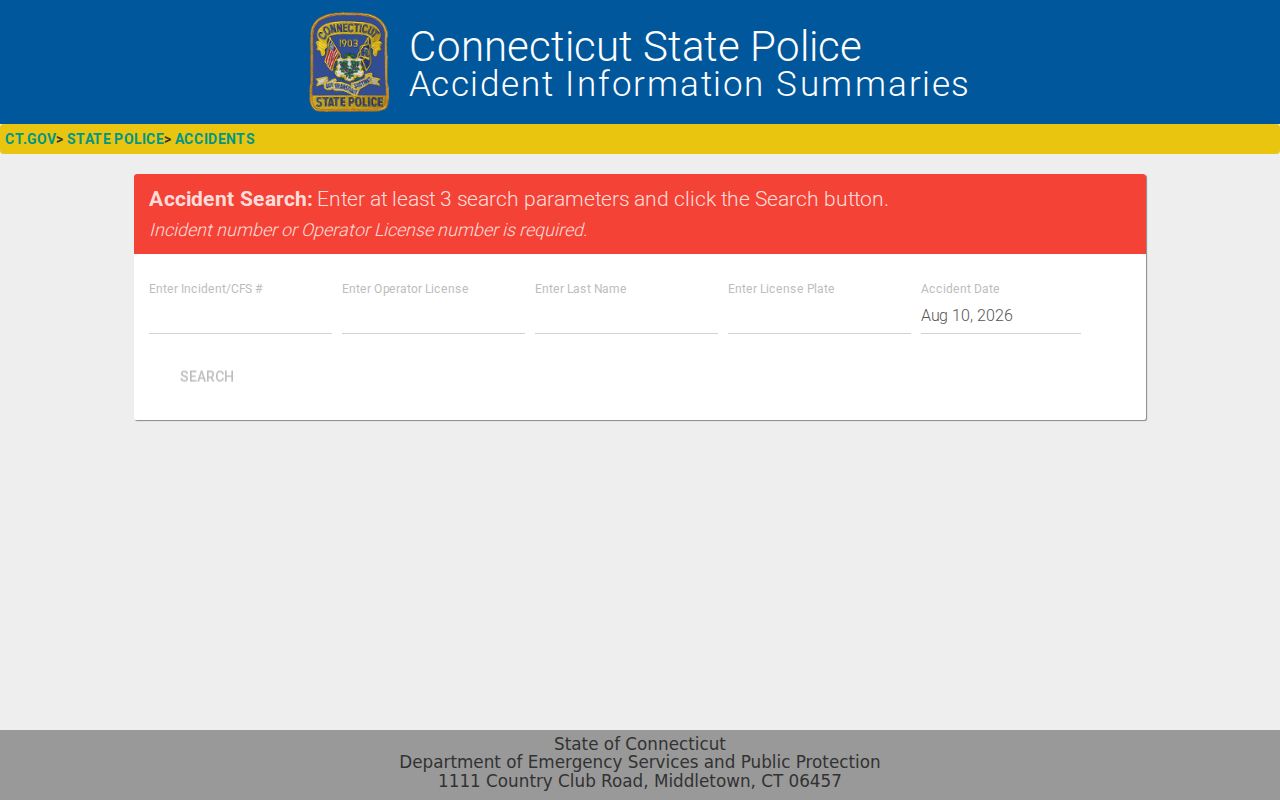
The free summary is available to involved parties for many crashes for 30 days. It is preliminary and does not replace the official accident report or a broader investigative record.
Connecticut Charges and Federal Records
Connecticut felony and misdemeanor classes describe statutory levels, not the exact sentence imposed. Felonies can range from Class E through Class A, with offense-specific rules and mandatory terms capable of changing the general range. Misdemeanors range from Class D through Class A. Superior Court Geographical Area sessions generally handle misdemeanor and less serious criminal business, while serious Part A matters operate at the Judicial District level. The docket and judgment control the result.
Federal records sit outside Connecticut systems. The FBI Identity History Summary is the official federal self-review channel. PACER and the U.S. District Court for the District of Connecticut cover federal court cases. The Bureau of Prisons locator covers federal custody. A Connecticut SPBI result, state docket, or CT DOC entry cannot substitute for any of those federal sources.
Note: A statutory charge class describes the law alleged or applied; it does not prove guilt or state the final punishment by itself.
Connecticut Criminal Records by County
Connecticut's eight county names are geographic labels, not operating county governments. The local layer instead follows the municipal police department, State Police troop, and state Superior Court location tied to the event. The 27 live locality hubs include the eight county geographies and 19 city or town routes. These major hubs help locate the right local creator without suggesting that a county sheriff or county clerk exists.
Fairfield County
Bridgeport, historical center · Largest county geography and major court hub
Hartford County
Hartford, historical center · Capital-region courts and justice agencies
New Haven County
New Haven, historical center · Major Superior Court and DOC hub
New London County
New London, historical center · Southeastern police and court routing
Litchfield County
Litchfield, historical center · Town and resident-trooper routing
Middlesex County
Middletown, historical center · Home geography for DESPP and SPBI
Stamford
Stamford · Municipal police and state Superior Court route
Waterbury
Waterbury · Municipal records and unified state custody route
Browse the full directory of all 27 Connecticut locality hubs to open the criminal-record route for any listed county geography, city, or town.