
How Connecticut Courts Handle Criminal Cases
Connecticut criminal cases move through a unified, state-administered court system. Superior Court Geographical Area sessions handle most arraignments, misdemeanors, criminal motor-vehicle matters, and early felony work. More serious felony matters may proceed in Judicial District or Part A sessions. The Appellate Court reviews qualifying trial judgments, and the Connecticut Supreme Court is the highest state court. That structure replaces the county-court model used elsewhere.
The Connecticut Judicial Branch clerk keeps the public court file. State's Attorneys serve judicial districts through the Division of Criminal Justice, but they are not elected county district attorneys and do not serve as the public file counter. A police agency retains its own incident narrative and original arrest allegations. Connecticut SPBI compiles reported arrest and disposition data into a criminal-history product. A court docket, police report, and rap sheet can describe the same event, yet each has a different purpose and custodian.
Connecticut Case Levels Explained
Two labels help place a Connecticut criminal case. A Geographical Area, often shortened to G.A., is a Superior Court location assigned criminal and motor-vehicle work for specific towns. A Judicial District, or J.D., is a state trial-court district. Part A generally handles more serious criminal matters. A felony may begin with arraignment in a G.A. session and later transfer, so the first court location is not always the last.
- Geographical Area
- A Superior Court location that handles assigned towns and much of the state's routine criminal docket.
- Judicial District
- A state trial-court district used for serious cases and other Superior Court business.
- Part A
- The Superior Court criminal part generally assigned more serious matters.
- Docket number
- The case identifier and the most reliable key for following a Connecticut court record.
A transfer does not erase the earlier docket trail. Follow any companion or transferred case number shown. Appellate review also affects finality. A public summary can lag a recent appellate ruling, while the updated judgment and final mandate control what happens next.
Running a Connecticut Judicial Branch Criminal / Motor Vehicle Case Look-up Search
The Connecticut Judicial Branch Criminal / Motor Vehicle Case Look-up separates pending cases from convictions. It also provides daily-docket and docket-number paths. Run the paths that fit the question. A name search may find an open case, while a separate conviction search may be needed for the outcome of an older prosecution.
- Open the official criminal and motor-vehicle lookup gateway.
- Search pending cases by defendant, then repeat with a docket number when one is known.
- Run the separate conviction route by defendant or docket. Neither route includes the other.
- Use Daily Docket to confirm a scheduled court appearance and note the court location.
- Contact the listed Superior Court clerk for the official file, certified copies, or archived material.
| Lookup Route | Type | Required | Scope |
|---|---|---|---|
| Convictions by Defendant | Route link | No | Name-based conviction display |
| Convictions by Docket | Route link | No | Exact conviction docket |
| Pending by Defendant | Route link | No | Open public cases by name |
| Pending by Docket | Route link | No | Exact pending docket |
| Daily Docket by Court | Route link | No | Calendar for a court location |
| Daily Docket by Defendant | Route link | No | Calendar by person |
The official gateway itself illustrates how Connecticut splits these routes. View the Judicial Branch criminal lookup source shown below.
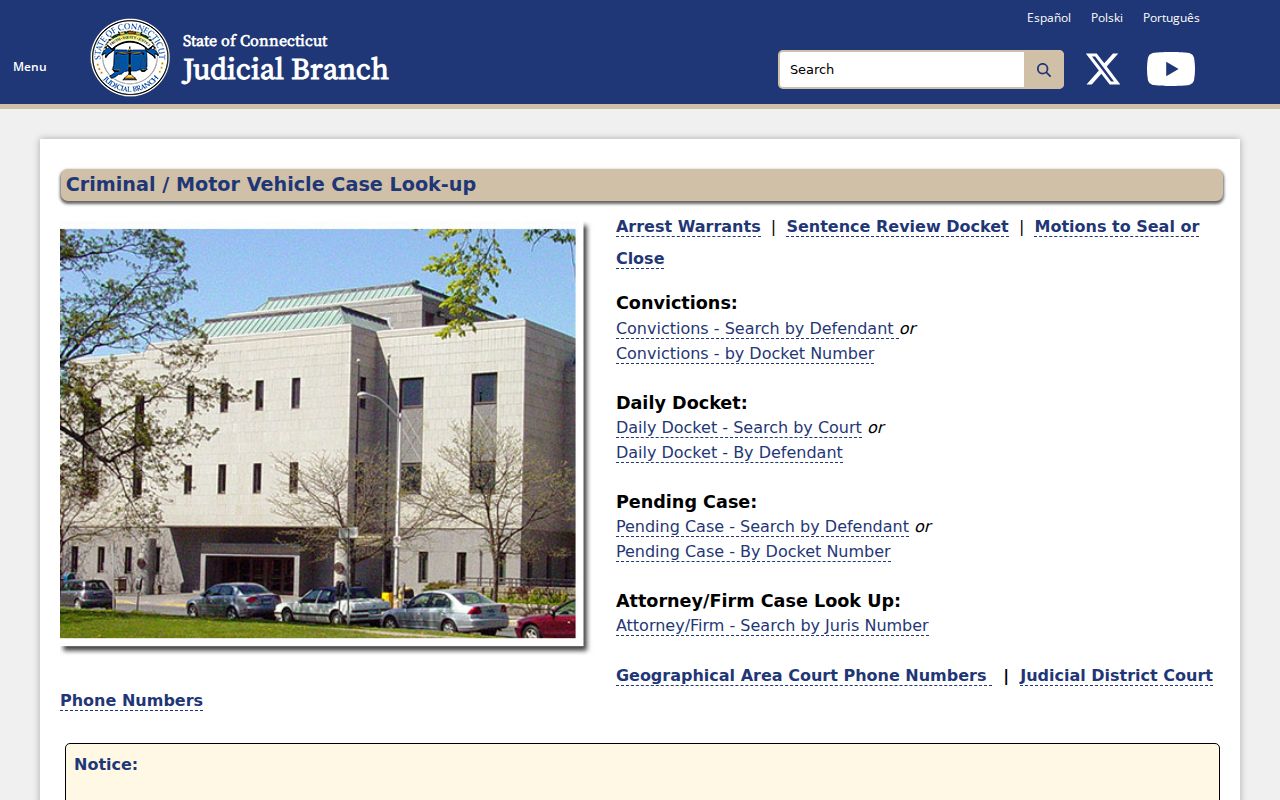
Its separate links are a practical reminder to search both status paths and save the docket number before seeking clerk help.
Note: Connecticut pending and conviction routes must be searched separately because neither route includes every public criminal case status.
Connecticut Case Searches Stay Separate
A common error is treating one empty search as proof that no Connecticut court case exists. Pending and conviction databases answer different questions. Web coverage also excludes juvenile matters, Youthful Offender files, erased or sealed cases, and other confidential categories. Conviction information is generally shown for a limited period rather than forever. The lookup changes as courts correct data, record pardons, and apply erasure.
Try a known docket number, name variants, and both pending and conviction paths. If the result stays blank, use old paperwork, event date, and court location to help the clerk identify an archived file. Connecticut FOIA does not require a town police department to supply a Judicial Branch case file. It may provide its own police record, subject to lawful redactions.
What a Connecticut Case File Contains
A Connecticut criminal case file is organized by docket and court location. The public summary may show basic dates, parties, appearances, charges, events, bond, disposition, and sentence. The Judicial Branch criminal bulk-data specification does not promise electronic copies of the underlying pleadings. Certified judgments, complaints, transcripts, and financial details may require direct file inspection or a focused clerk request.
| Docket & Court | Unique case number, file location, case type, status, file date, and return date. |
|---|---|
| Charges | Filed count, statutory citation, classification, and later count-level outcome. |
| Appearances | Party roles and attorney or firm appearances, including a juris number where shown. |
| Events | Arraignment, plea, continuance, motions, hearings, trial, judgment, and sentencing entries. |
| Disposition | Separate result for each count, such as conviction, acquittal, dismissal, or nolle. |
| Sentence | Public confinement, probation, special parole, and related judgment terms where reported. |
Read each count. A case can be closed while one charge produced a conviction and another was dismissed or nolled. Bond shows a pretrial release order, not guilt. An attorney appearance does not prove that lawyer handled every earlier event. A linked companion docket remains a distinct Connecticut court file and needs its own review.
When Connecticut Cases Go Missing
An absent online docket can have several sound explanations. The name may differ, the matter may fall outside the web display window, or the file may be archived. Erasure can remove a qualifying case from ordinary public view. Juvenile and Youthful Offender matters are generally confidential. A recently transferred or appealed case may also sit under another docket or location.
Start with any paper notice, bond form, arrest report, or prior docket number. Search by docket when possible. Then use the statewide Judicial Branch directory to contact the proper clerk. Ask whether the file is on-site or archived, which parts remain public, and how to request a certified disposition. Court Service Centers offer public computers and procedural resources, but they do not give legal advice. The Judicial Branch also publishes court-record access guidance for the clerk fallback.
Note: A missing Connecticut web result does not prove that no case was filed or that no historical record exists.
Connecticut Criminal Case Stages
A Connecticut arrest is followed by prompt presentment or arraignment, where charges and release conditions are addressed. Prosecutors decide what counts to file, so the court charge can differ from the police allegation. Serious matters may transfer from a G.A. session to Part A. Discovery, motions, negotiations, and hearings follow. The matter may end by plea, trial judgment, dismissal, acquittal, or nolle.
Case flow: Charges Filed › Arraignment › Pretrial › Plea or Trial › Disposition › Sentencing
Disposition must be read in Connecticut terms. A guilty plea or verdict creates a conviction. An acquittal is a not-guilty judgment. A dismissal ends the charge without conviction. A nolle means the prosecutor declines to proceed at that time; it is not a same-day dismissal and covered records generally erase after thirteen months. Probation and special parole are sentence terms, while a later violation allegation is not automatically a new conviction. The Judicial Branch's criminal-process answers provide more official context on these court stages.
Connecticut Charges Can Change
The police charge, prosecutor charge, and final judgment mark different points. The arresting agency records the initial allegation. The Division of Criminal Justice files the prosecuted charge in Superior Court. The clerk's judgment records the count-level outcome. Connecticut SPBI then relies on reported arrest and disposition data for its statewide history.
| Source | Best Evidence | Does Not Replace |
|---|---|---|
| Police file | Incident narrative and original arrest allegation | Final court judgment |
| Superior Court file | Filed counts, events, disposition, and sentence | Full police investigation |
| Connecticut SPBI | Compiled identity-linked history within product scope | Original court documents |
Compare sources by docket, dates, and charge statute. If SPBI lacks a disposition that the court entered, obtain the certified disposition and use the repository correction route. Do not merge an old police allegation with a later conviction outcome. The court record is the right source for what was prosecuted and decided.
Note: A Connecticut police allegation, prosecutor charge, and final judgment may use different counts without representing a records error.
Reading Connecticut Case Dispositions
Disposition is the result entered for a charge. It is more precise than overall case status. A pending label only says the docket lacks a final result. A disposed case can contain several outcomes. Connecticut's erasure rules also give some results later consequences for public access, so an older private copy may no longer match the current official system.
- Conviction
- A judgment of guilt based on a plea or verdict.
- Acquittal
- A not-guilty judgment; qualifying records erase after the appeal period or final review.
- Dismissal
- The prosecution ends without conviction, subject to Connecticut erasure timing.
- Nolle prosequi
- The prosecutor declines to proceed then; covered records generally erase after thirteen months.
- Violation of probation
- An allegation of noncompliance with an existing sentence, not automatic proof of a new crime.
Charge class also does not reveal the sentence imposed. Look for the judgment and sentence fields. If an appeal followed, review the appellate docket and updated trial judgment. The final mandate determines what the Superior Court must do and can affect when a disposition becomes final.
County Sources for Connecticut Case Records
Connecticut has eight county geographies but no operating county government and no county criminal clerk portal. Do not search for a county clerk of courts. The full criminal file belongs to the state Superior Court clerk at the docket's assigned court location. The locality still matters because it helps identify the right G.A. or Judicial District assignment and the police agency that created a separate incident report.
Use the Connecticut locality directory to start from the town or county geography connected with the event. The directory covers all 27 live project localities and routes readers to local record context without inventing a sheriff or county courthouse. For court documents, follow the statewide Judicial Branch directory to the listed clerk. For the police narrative, contact the municipal department, State Police troop, campus agency, or other creator.
The split matters. A Superior Court clerk generally cannot produce the police department's investigative narrative. A municipal FOIA office cannot certify the Judicial Branch judgment. Connecticut SPBI provides a compiled criminal-history product, not the pleadings or complete docket. The Division of Criminal Justice record-routing page reinforces these separate sources. Use each custodian for the record it created.
Note: Connecticut county names identify geography, while state Superior Court clerks and local police agencies remain the actual record custodians.