
Connecticut SPBI at a Glance
The full repository unit is the Connecticut Department of Emergency Services and Public Protection, Division of State Police, State Police Bureau of Identification. Public materials distinguish its Fingerprint Identification Unit from the State Police Criminal Records Unit. Together, these functions support identity matching, criminal-history requests, corrections, and authorized state and national workflows. The official Connecticut SPBI page publishes the current products, fingerprint instructions, fees, mailing rules, and contact details.
Chapter 529, including the statewide police-identification authority around CGS §29-11, is SPBI's institutional home. CGS Chapter 961a defines criminal-history record information and governs collection, access, dissemination, accuracy, and correction. Connecticut SPBI is the repository point between municipal and state arresting agencies, the Judicial Branch, authorized users, and FBI systems. It does not replace police incident files, court dockets, or CT DOC custody data.
Connecticut SPBI
1111 Country Club Road
Middletown, CT 06457
Criminal Records: 860-685-8480
Fingerprint questions: 860-685-8270
Connecticut SPBI $36 Search
The lowest-cost public product on DPS-0846-C is the Connecticut Only Name/Date of Birth search. Its $36 result says whether a Connecticut record exists. It does not provide the record itself. That boundary matters. A positive answer is not a case file, a police narrative, or a fingerprint-confirmed identity match. A negative answer must not be restated as proof that no arrest or case exists outside the product's scope.
The form requires requester details and the subject's identifying information for a name route. Exact name and date of birth improve the search, while maiden or alias names can matter. SPBI warns that it is not responsible for errors or omissions. When the aim is to review one's own history with strong identity confidence, the fingerprint-supported product is the sounder route.
What Checks Connecticut SPBI Offers
Connecticut SPBI offers separate products because identity method, legal authority, output, and recipient can differ. The public DPS-0846-C choices include an existence response, a name and date-of-birth conviction history, and a fingerprint-based Connecticut conviction history. A federal component appears only in a workflow authorized by state statute or federal law. The form and service code in force for the specific purpose control the final price and delivery route.
| Product | Who may order | What it returns | Current fee |
|---|---|---|---|
| CT Only Name/Date of Birth search | Public requester using DPS-0846-C | Existence or no-existence answer only | $36 |
| CT Only Criminal Conviction History by name/DOB | Public requester with accurate subject data | Connecticut conviction copy only if found | $75 |
| CT Only Criminal Conviction History by fingerprint | Person participating in the fingerprint route | Fingerprint-matched Connecticut conviction history | $75 plus capture |
| Authorized federal component | Statutorily authorized coded workflow | Permitted FBI-supported response | Follow the current service code |
| Letter of Good Conduct | Person needing the purpose-specific visa, immigration, foreign adoption, or foreign-entry response | DPS-181-C good-conduct response | Confirm on the current form |
| Absolute Pardon personal history | Pardon applicant reviewing their own record | Fingerprint-supported SPBI history | $75; waiver may be available |
The official DPS-0846-C form remains the key product comparison for general requests. DESPP also maintains a consolidated State Police forms hub. Purpose-specific CCHRS directions can supersede a paper route for that named program.
Note: The product label controls what the Connecticut SPBI response proves; an existence result is not a conviction history.
Connecticut SPBI CCHRS Service Codes
The Connecticut Criminal History Request System is not a public database where any visitor types a name and sees convictions. It is a service-code and pre-enrollment system. An eight-character agency-provided code identifies the product, recipient, and fee. The program or agency requiring the official workflow must supply it. Guessing a code can misroute the response or produce an unusable request. DESPP keeps current manuals and privacy forms on its state and national check program page.
The official CCHRS portal shows the controlled pre-enrollment entry:
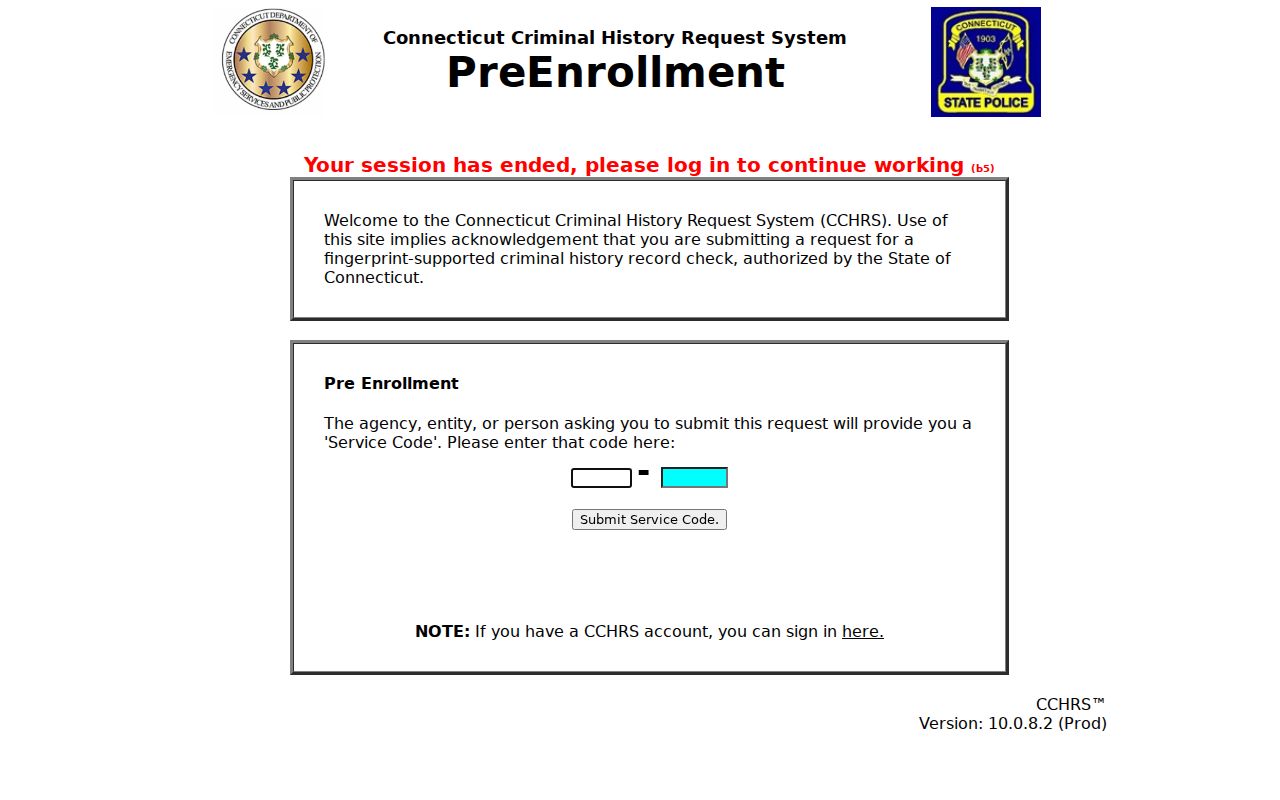
After enrollment, the system generates a tracking number and barcode. Bring the confirmation to the fingerprint appointment with accepted government photo identification. CCHRS may return results electronically where the coded program allows, while general SPBI directions still call for mail and do not allow email, fax, drop-off, or pickup.
| Control | Required | Purpose |
|---|---|---|
| Agency Provided Service Code | For coded workflows | Sets product, fee, recipient, and authority |
| Requester identity and email | Yes electronically | Creates the enrollment and communications record |
| Tracking number and barcode | At SPBI capture | Connects fingerprint capture to enrollment |
| Government photo ID | At capture | Confirms the applicant's identity |
The Path Into the Connecticut SPBI Repository
A Connecticut criminal-history cycle begins when an authorized agency makes a qualifying custodial arrest and records identity, charges, and fingerprints. Municipal police, Connecticut State Police, campus departments, tribal agencies, and special jurisdictions may create the submission. Connecticut has no county sheriff layer. SPBI uses fingerprints to join the event to the correct state identity record.
Data flow: Local Arrest › Fingerprint Submission › Connecticut SPBI › Superior Court Disposition › Rap Sheet
If prosecutors pursue the case, the state Judicial Branch creates the docket and final result. Reported dispositions update SPBI. A transaction control number helps associate the fingerprint event with later case data, though it is not a public CCHRS search field. Names can vary, identifiers can fail to match, and older paper processes can leave gaps. No current statewide disposition-completeness percentage was published, so a precise rate would be misleading.
Why Connecticut SPBI Results Differ
One incident can create three records. Police retain the factual narrative and original allegations. The Superior Court file shows filed charges, events, disposition, and sentence. Connecticut SPBI compiles reported identity, arrest, and disposition data into its product. Timing and scope explain many differences. A recent event may appear with police or CT DOC before a repository update. A prosecutor may file different charges from those listed at arrest. A later erasure can remove public court data while an old copy remains elsewhere.
Start reconciliation with the exact docket, dates, aliases, and a certified court disposition. Do not merge an arrest allegation with the judgment. If a court result is right but the SPBI line is wrong, use the repository challenge route. If the judgment itself is wrong, work with the proper Superior Court clerk. If a police narrative is disputed, follow the creating agency's correction or FOIA process.
Note: The certified Superior Court disposition is the strongest source for reconciling a disputed outcome in a Connecticut SPBI record.
Connecticut SPBI Check Ordering Steps
Pick the official product before collecting fingerprints or paying a fee. The $36 and $75 name routes use DPS-0846-C. Fingerprint workflows require the correct CCHRS or program instruction, a barcode, and capture. General processing time varies with mail, fingerprint quality, rejected prints, service-code routing, review, and current volume. SPBI does not publish one universal instant-result promise.
- Define the needed answer. Choose existence only, a Connecticut conviction copy, or a fingerprint-supported review of your own history.
- Use the current SPBI page, DPS-0846-C, or the exact service code supplied by the authorized program. The Absolute Pardon instructions supply their own route. Do not invent a code.
- For fingerprint service, pre-enroll in CCHRS, print the tracking and barcode confirmation, and book SPBI or confirm a participating local police process.
- Submit the required form, identifiers, fingerprint card or Livescan capture, and separate exact payments through the stated channel.
- Read the product label on the result. Pull the Superior Court record or creating police file when an entry needs source detail.
Local police availability, capture method, hours, and charges vary. Use Browse Connecticut Counties to reach the right locality hub and confirm its fingerprint service. A local department captures prints; it does not become the repository or choose the purpose code.
Connecticut SPBI Separates Its Fees
A fingerprint appointment fee is not the criminal-history product fee. At the SPBI counter, published instructions list $15 for capture and $75 for the Connecticut criminal-history product. An authorized federal component is separate and follows the service code. Local police may set a different capture charge. Each fee is paid separately, and SPBI directions call for exact amounts by check, money order, or exact cash at the fingerprint counter.
The official SPBI product page displays the current fee and mail details:
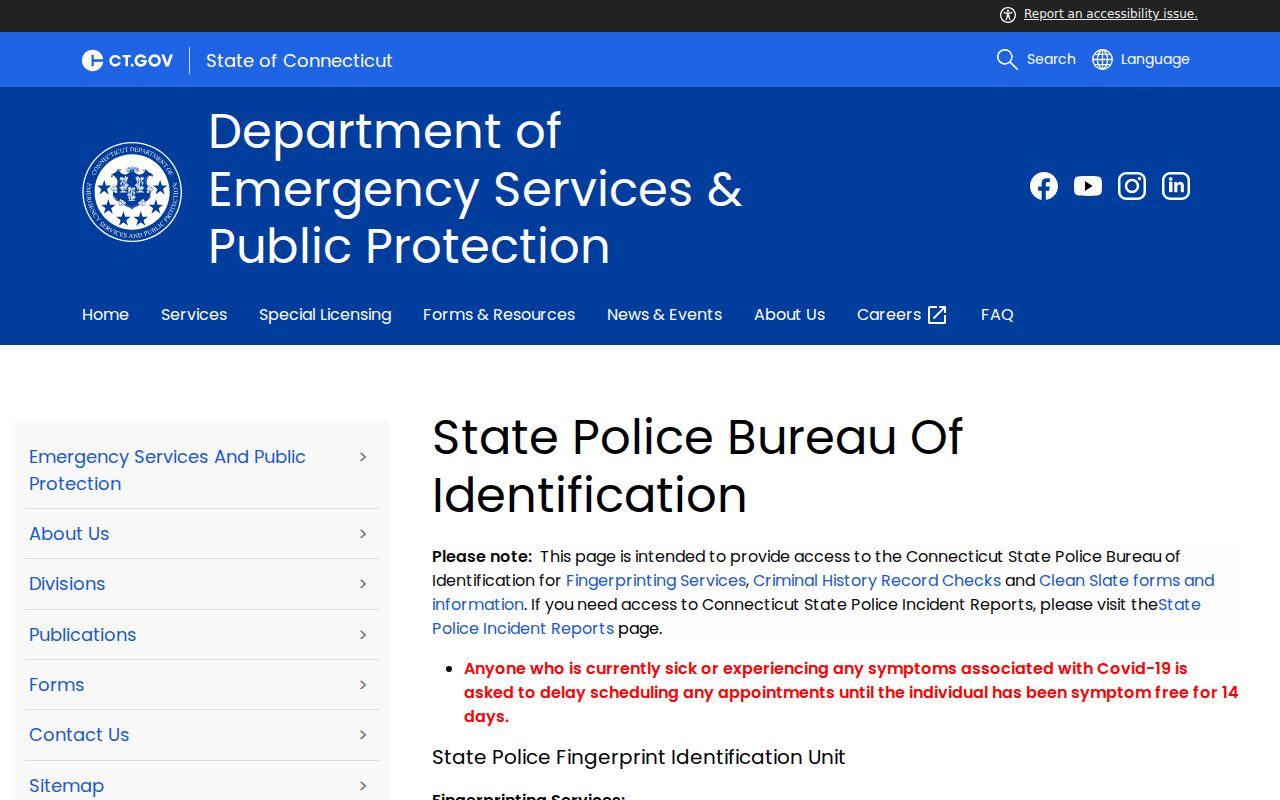
Check that page just before ordering. A posted future fee notice should not be treated as already effective. Purpose-specific pages can also quote a federal line that differs from a general listing, so the current service code wins.
Comparing Connecticut SPBI and Local Records
Connecticut SPBI provides a statewide compiled history within the product's rules. It is useful when reported records from more than one police or court location must be reviewed together. The original source still carries facts the rap sheet does not. Connecticut's Superior Court holds the case file, and the arresting police agency holds the incident or arrest narrative. Neither source replaces the other.
| Question | Connecticut SPBI check | Original local or court record |
|---|---|---|
| Coverage | Reported statewide history within product scope | One creating agency or Superior Court case |
| Identity | Name-based or fingerprint-supported | Tied to the incident or docket |
| Freshness | Depends on submission and matching | Changes as the source record moves |
| Detail | Compiled summary entries | Narratives, filings, events, and certified outcome |
| Best use | Official statewide product or self-review | Understanding and proving a specific event |
Connecticut's locality layer is municipal and state-agency based, not county government. The counties and localities directory routes the source-file follow-up without pretending an eight-county clerk or sheriff system exists.
Note: A Connecticut SPBI compilation and an original police or court file answer different questions and should not be merged.
Connecticut SPBI History and CCHRS
SPBI grew from the State Police identification function into computerized fingerprint and criminal-history services inside DESPP. Connecticut's statewide UCR system was established under CGS §29-1(c), and the annual Crime in Connecticut publication began in 1978. Current records work links electronic arrest submissions, court dispositions, Livescan capture, and controlled state or federal responses.
CCHRS adds pre-enrollment, service codes, barcode tracking, and electronic return for defined workflows to the older mail and fingerprint-card channels. It does not erase the older routes for every request. The correct lesson is procedural: follow the current product page and purpose-specific instruction rather than assuming all Connecticut checks share one portal, one recipient, or one turnaround.
Connecticut SPBI Record Error Corrections
CGS §54-142l provides the accuracy and challenge framework for a Connecticut criminal-history record. Begin with a fingerprint-supported copy of your own SPBI history. Review each arrest cycle, charge, disposition, alias, and date. Obtain a certified disposition from the correct Superior Court clerk when the repository line does not match the judgment. The SPBI Criminal Records Unit can then identify the documents needed for a correction.
- Order your own fingerprint-supported Connecticut SPBI record and keep the CCHRS barcode, receipt, and tracking information.
- Mark the exact arrest cycle or field in dispute, then compare it with the official police or Superior Court source.
- Obtain the certified disposition or other authoritative document and follow the SPBI challenge directions under §54-142l.
- After the source and repository act, order or review a fresh official record to confirm the change.
A repository fix does not rewrite a police narrative, and a clerk correction does not automatically fix an old private copy. Correct the authoritative systems first, then notify any holder of an obsolete copy with proof of the official change.
Connecticut SPBI Clean Slate Review
A missing erasure is handled through a distinct DESPP route. First obtain a current SPBI history. Then use DESPP-0847-C to identify names and aliases, date of birth, contact details, docket or case, and the reason the conviction appears eligible for erasure. The request can be sent to DESPP Legal Affairs by the email or mail channel listed on the official Clean Slate eligibility page.
The process matters because Connecticut's Clean Slate rollout depends on data moving among DESPP, the Judicial Branch, DOC, prosecutors, and CJIS systems. It is not one database switch. The official program reported that erasures resumed after delays tied to aging systems and data quality. A hearing route exists when an eligible conviction appears not to have been erased.
Note: Clean Slate review requires a current Connecticut SPBI history so DESPP can identify the exact record still in dispute.