
Connecticut Sex Offender Checks
The official starting point is the Connecticut registry disclaimer and entry gate. Read it before accepting. DESPP states that the registry is a community-notification system. It does not show every person who has committed sexual misconduct, every pending case, or every protected record. It also does not assign a current danger score to each listed person.
Choose a route that fits the question. A known-person check should compare aliases, photograph, age or date of birth, physical descriptors, offense, and address. A neighborhood check can start with an address, ZIP, town, or county geography, then use the map and list views together. The county dropdown is only a location filter. Connecticut counties do not operate registry counters. For a local compliance concern, use the correct municipal police department or State Police troop found through the Connecticut counties and localities directory.
Search flow: Official Entry › Search Fields › Profile Match › Status and Address Review › DESPP or Local Police Follow-up
Connecticut Uses Duration Categories
Connecticut does not publish a Level 1, Level 2, or Level 3 risk score as its registry framework. The controlling rules are tied to the qualifying offense, conviction history, release into the community, and any court order. Under Connecticut General Statutes Chapter 969, an offense against a minor or a nonviolent sexual offense generally carries a ten-year duty under §54-251. A repeat qualifying conviction can require life registration. A sexually violent offense generally carries a lifetime duty under §54-252.
Out-of-state, federal, or tribal cases require a Connecticut comparability review and a look at the person's continuing duty elsewhere. A court may also order registration when a felony was committed for a sexual purpose. These rules make shorthand labels risky. The offense name alone may not reveal the correct duration, especially when conviction dates, prior cases, or a dissemination order matter.
| Connecticut category | General duration | Verification requirement |
|---|---|---|
| Offense against a minor or nonviolent sexual offense | Generally 10 years under §54-251 | Return DESPP address verification as directed under §54-257 |
| Repeat qualifying registration conviction | Life under §54-251 | Return DESPP address verification as directed under §54-257 |
| Sexually violent offense | Life under §54-252 | Return DESPP address verification as directed under §54-257 |
| Out-of-state, federal, or tribal duty | Case-specific under §54-253 | Follow the Connecticut duty and DESPP verification schedule |
Federal SORNA tiers should not be pasted onto Connecticut profiles. Connecticut OPM has stated that the state is not federally SORNA-compliant, yet the state registry remains the official Connecticut source.
Connecticut Sex Offender Registry Search Steps
The public registry can be reached from the Connecticut State Police services page, then opened through the official Connecticut search interface. That state entry helps confirm the correct registry if a saved vendor address changes between communitynotification.com and sheriffalerts.com. The Connecticut office identifier is 54567.
- Open the DESPP-linked registry and read the accuracy and misuse disclaimer. Accept it to reach the public search.
- Choose a name or location route. Begin broad, then add first name, town, ZIP, address, or a live radius option to narrow the list.
- Compare several identity fields. Use aliases, photograph, descriptors, age, offense, and address text instead of matching one common name.
- Read the registration and verification labels. Contact the Registry Unit or proper local police agency when a field appears wrong or stale.
| Field or control | Type | Required | Use |
|---|---|---|---|
| Accept or Decline | Buttons | Yes to enter | Acknowledges the registry terms |
| Last and First Name | Text | Conditional | Known-person route; aliases may help |
| City/Town or County | Location control | No | Filters Connecticut geography |
| ZIP Code or Address | Text | Conditional | Starts a proximity search |
| Radius | Dropdown | Conditional | Uses the distances offered live |
| Map or List | View tabs | No | Changes how results are shown |
| Email Notifications | Enrollment link | No | Adds free proximity notices |
Note: Connecticut registry searches should compare several identity fields because a common name or map pin alone is not a reliable match.
NSOPW and Connecticut Locations
A cross-border concern calls for a second official source. The U.S. Department of Justice runs the National Sex Offender Public Website, which searches public information supplied by participating jurisdictions. It can help when a person may have moved between Connecticut and a neighboring state. It does not replace the Connecticut entry for a Connecticut profile.
The official NSOPW interface illustrates the national name and location routes:
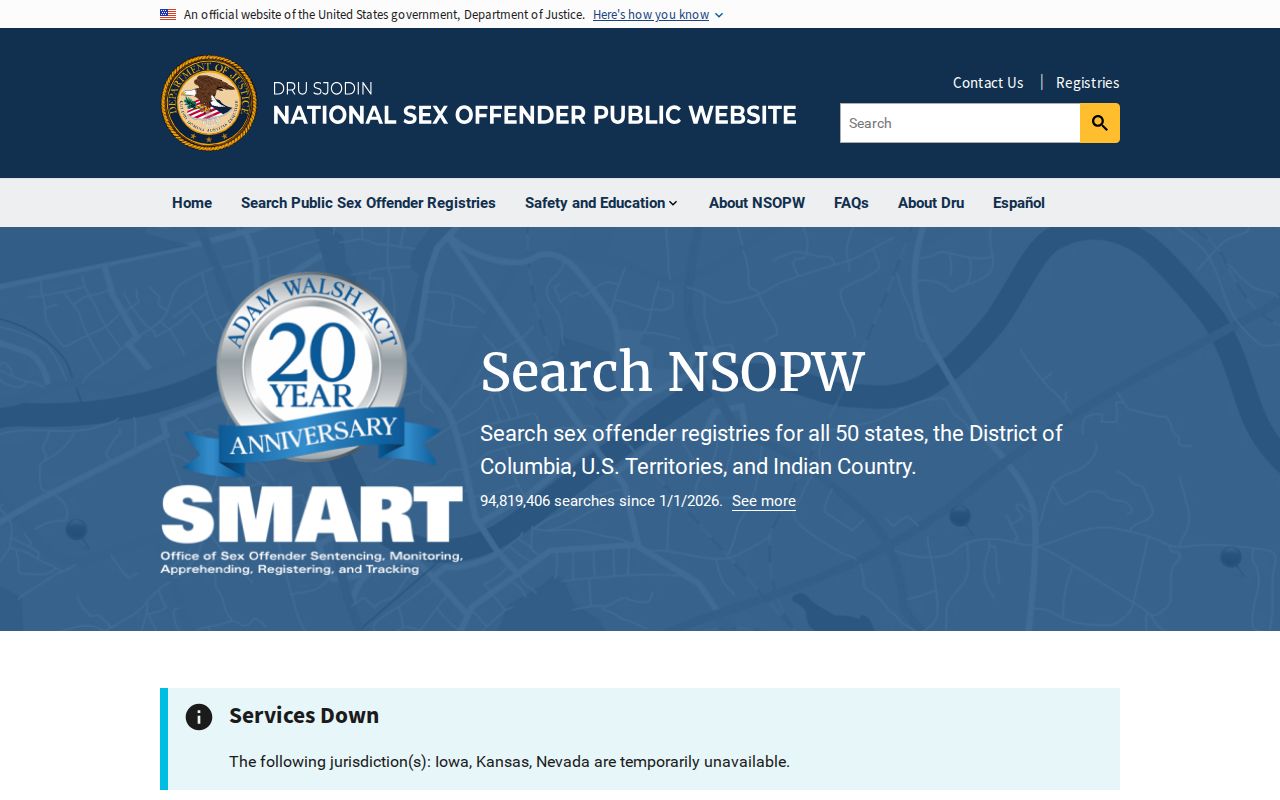
Connecticut reportedly does not supply geographic coordinates for NSOPW address-radius results. Run the Connecticut registry's address and map search for local proximity, then use NSOPW for interstate discovery. Always return to the source jurisdiction for the controlling profile.
What a Connecticut Registry Profile Lists
A public profile is an identification and community-notification record, not a full criminal history. It may show enough detail to distinguish people and understand the registration basis. Some fields can be blank or qualified as last known. That does not prove DESPP lacks administrative information.
| Identity | Name, aliases, photograph, age or date of birth, sex, race, and physical descriptors |
|---|---|
| Distinctive details | Height, weight, hair, eyes, and scars, marks, or tattoos where published |
| Location | Address or last-known address, town, ZIP, and map presentation |
| Qualifying record | Offense, statute or description, conviction date, court, and docket |
| Registry status | Registration duration, release information, status, and verification indicators |
| Other public fields | SPBI number, arresting agency, local case number, supervision, or vehicles when collected and published |
Fingerprints, DNA, internet identifiers, treatment material, victim identity, Social Security numbers, nonconviction arrests, and investigative notes are not ordinary public-profile content. Connecticut law separates data collected to administer the registry from information released for public notification.
Connecticut Registry Email Notifications
The Connecticut portal promotes free email notifications tied to an address and selected proximity. Alerts can support ongoing awareness after a search. Save the confirmation and review the chosen area so the coverage is clear. A notice still depends on the address, radius, and changes reported to the registry. It is not a promise that every safety concern will trigger an email.
Run a fresh search when a specific question arises. Maps are visual aids, and pins may be imprecise. The address text and any current, last-known, or verification qualifier carry more meaning than the marker alone. Near New York, Rhode Island, or Massachusetts, pair Connecticut alerts with NSOPW and the neighboring state's official registry.
Note: Connecticut email alerts depend on the saved address, radius, and reported changes, so they cannot guarantee notice of every concern.
Registry Levels and Requirements in Connecticut
Registration starts through the court or releasing agency. Connecticut's DPS-694-C-3 advisement form records identity, release information, SPBI number or date of birth, docket, full residential address, deadline category, and signed acknowledgments. A covered person released into the community generally reports in person within three days unless the governing form or order says otherwise. A person arriving from another jurisdiction must act without undue delay, described in the research as within five business days.
Address verification then operates under §54-257. DESPP sends the required material and notifies the municipal police department or State Police troop with jurisdiction. Name, address, status, and other reportable changes must be updated. Advance international-travel reporting also applies. Failure to register, verify, or report required changes can create a separate criminal case, but the public should report a factual discrepancy rather than decide from a web page that a crime occurred.
Research found no uniform statewide school or park residence-distance ban. Local ordinances and individual supervision terms must not be described as one Connecticut registry rule.
When Connecticut Addresses Look Stale
Do not visit the address or confront anyone. First, note the profile URL, search date, exact field, and whether the address is marked current or last known. Repeat the search by name, alias, town, and ZIP. Check NSOPW if an interstate move may explain the gap. A missing result may also reflect spelling, timing, a transfer, a court restriction, or an offense outside the public categories.
Send the factual issue to the DESPP Sex Offender Registry Unit or the municipal police department or State Police troop with jurisdiction. The Registry Unit can be reached at 860-685-8060 or SORU@ct.gov. Use 911 only for immediate danger. DESPP and police determine whether a required update was late, the portal is still processing it, or a legal restriction applies.
Note: A stale-looking map pin is a reason to verify the official profile, not proof of a new offense or registration failure.
Connecticut Registry Data Reaches Police
Connecticut's central-to-local flow differs from states built around county sheriffs. DESPP maintains the authoritative statewide registry. It then sends notice to the police department or State Police troop responsible for the registrant's location. Local agencies may retain registration material and investigate noncompliance. A move across town lines can change the police jurisdiction even though DESPP keeps the same statewide system.
The portal's county filter includes all eight county geographies, but none is a registration office. Use Browse Connecticut Counties to reach the relevant city, town, or regional hub, then confirm which local agency serves the address. A local list may help answer a compliance question. It does not replace the DESPP registry or create a separate risk score.
Using the Connecticut Sex Offender Registry Lawfully
Registry information should support personal, family, and community awareness. It should not be turned into added accusations or a private watch list. A listing identifies the qualifying registry offense. DESPP expressly warns that it has not assessed each person's present dangerousness or specific risk of reoffense.
For a disputed field, contact SORU with the search date and profile link. For suspected noncompliance, report the observed facts to the proper local police agency. For immediate danger, call 911. A lawful Connecticut sex offender lookup ends with careful source checking, not republication of private details.
Note: Connecticut registry information identifies a qualifying registration record, not a prediction that a person will commit a future offense.